
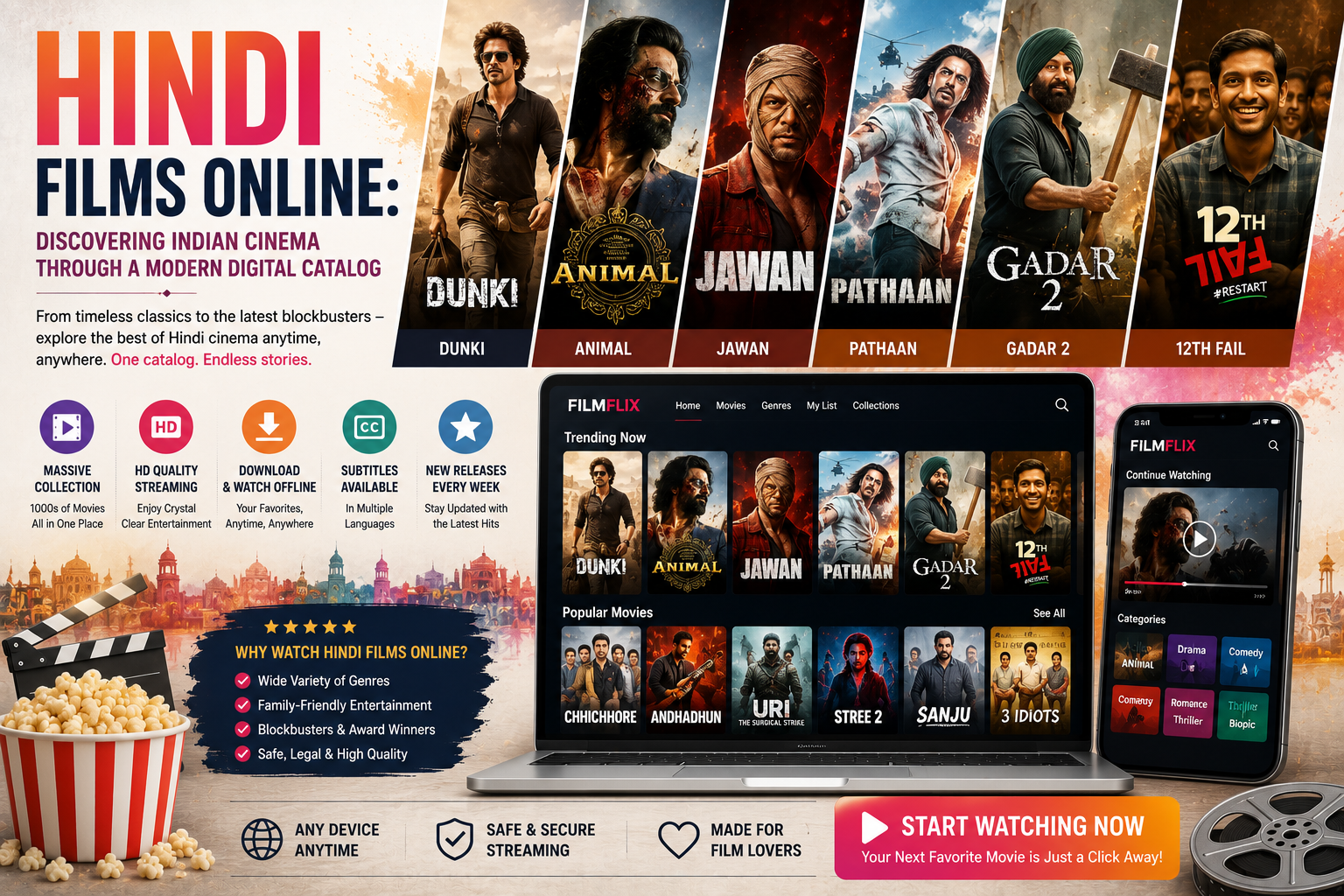
Hindi cinema has developed into one of the world’s most widely recognized film cultures, with audiences extending far beyond India’s borders. Its digital evolution has changed not only where Hindi-language films are watched but also how viewers discover them. Instead of depending exclusively on cinema schedules, television broadcasts, or physical collections, audiences can explore a much broader range of Indian entertainment through connected devices. For viewers searching for हिंदी फिल्में ऑनलाइन देखें, an online catalog provides a convenient starting point for exploring Hindi-language cinema in a flexible, on-demand environment.
From Bollywood Tradition to a Wider Hindi Film Landscape
The phrase Hindi cinema is often used interchangeably with Bollywood, but the wider Hindi-language film ecosystem is considerably broader. It includes mainstream commercial productions alongside independent projects, smaller-scale dramas, experimental filmmaking, crime cinema, comedy, romance, action, family entertainment, thrillers, historical subjects, and other formats.
This breadth is increasingly visible through digital distribution. A viewer is no longer restricted to whichever Hindi productions happen to receive prominent theatrical promotion or television placement. An online catalog can bring different genres and periods of filmmaking into the same browsing environment, making it easier to explore beyond the most familiar names.
This is particularly valuable for audiences outside India. Hindi-language cinema has a substantial international following, but the availability of individual films can vary considerably between countries. Digital access reduces some of those geographical limitations by creating a direct route from the viewer to the catalog.
Why Hindi Cinema Works So Well in a Digital Environment
Hindi films have traditionally attracted audiences through a combination of genres, music, visual spectacle, humor, drama, and cultural familiarity. Digital catalogs complement this diversity because they allow viewers to select entertainment based on mood rather than a predetermined broadcast schedule.
Someone may want a light comedy after work, a thriller on a quiet evening, or a family-oriented film during the weekend. An online catalog can accommodate these changing preferences without requiring the viewer to wait for a particular title to appear.
The organization of the catalog therefore becomes important. Genre categories, curated collections, search functionality, and clear content shelves can transform a large library into an environment that is easy to explore. Rather than scrolling endlessly through unrelated titles, viewers can move toward the type of Hindi entertainment that interests them.
This also creates opportunities for discovery. A viewer who arrives with a narrow preference may encounter other genres simply because the digital environment makes them visible.
Hindi-Language Entertainment Beyond India’s Borders
Hindi cinema has a long-established international audience, particularly among Indian communities living in the Gulf, North America, Europe, Southeast Asia, and other regions. Digital distribution has expanded this relationship by making Hindi entertainment less dependent on local broadcasting infrastructure.
For viewers living abroad, online access can be especially useful when local cinemas do not regularly screen Hindi-language films or when television schedules offer only a limited selection. A digital catalog can provide a more consistent way to explore Indian entertainment regardless of location.
Language also plays an important role. Hindi-speaking audiences can experience films in their preferred language, while subtitles and multilingual interfaces can help non-Hindi speakers explore the same catalog where such features are available.
This creates a wider cultural exchange in which Hindi cinema can reach international viewers without losing its linguistic identity. The original language remains central, while digital technology provides the infrastructure for global access.
The Importance of Music and Audiovisual Quality
Music has long been closely connected with Hindi cinema and its wider popular culture. Film soundtracks often exist independently as part of the music landscape, while songs, background scores, choreography, and sound design contribute to the overall identity of Indian filmmaking.
The digital presentation of Hindi cinema therefore depends on more than simply delivering a video file. High-quality audio and visual playback can make a significant difference to the experience, particularly on modern televisions and larger displays.
Contemporary streaming technology combines efficient video compression with improved audio delivery and adaptive playback. These systems help maintain a balance between quality and bandwidth, allowing detailed audiovisual content to reach viewers across different network conditions.
When the infrastructure performs correctly, the technical layer disappears. The viewer can concentrate on the film rather than buffering indicators, complicated settings, or repeated interruptions.
A New Relationship With Movie Discovery
Traditional movie discovery was strongly influenced by theaters, television channels, newspaper advertisements, entertainment magazines, and recommendations from friends. Digital platforms have introduced an additional discovery layer in which search tools, genre shelves, curated collections, and recommendations can influence what audiences encounter.
This change is especially significant for Hindi cinema because the catalog is so extensive. A viewer who knows exactly what they want can search directly, while someone without a specific title in mind can browse categories and discover something unexpected.
The digital shelf becomes an active part of the entertainment experience. Instead of simply presenting films, it provides different paths through the catalog. Genre organization can guide one viewer, recent additions another, while broader collections can help newcomers understand the range of Hindi-language entertainment available.
The best interfaces make this exploration feel natural rather than technical. Viewers should be able to move between categories without losing their place or repeatedly navigating through unnecessary pages.
From Catalog to Playback Without Unnecessary Barriers
A streaming platform’s usability becomes particularly noticeable when a viewer has already decided what to watch. At that point, complicated registration processes, excessive redirects, and intrusive pop-ups can create unnecessary friction between discovery and playback.
Moviewala emphasizes a direct catalog experience in which viewers can browse the available Hindi entertainment and select a title directly from the digital shelf. The absence of a mandatory sign-up wall keeps the initial browsing process open, while a cleaner interface without annoying pop-ups allows the viewer to remain focused on the catalog.
One-click access is particularly useful when exploring several possibilities. A viewer can open one title, return to the shelf, examine another category, and make a final choice without repeatedly dealing with unnecessary barriers.
This creates a more relaxed relationship with the platform. The technology supports the viewing decision instead of trying to dictate it.
Hindi Cinema Across Television, Computers and Mobile Devices
Modern streaming has made the viewing screen increasingly flexible. Smart TVs provide a natural environment for home cinema, while laptops and desktops offer convenient access for individual viewing. Tablets and smartphones make the same digital catalog available when audiences are away from a larger screen.
This flexibility is important for international Hindi-speaking audiences, whose daily routines can differ substantially from those of viewers in India’s major entertainment markets. Online access allows people to decide not only what they want to watch but also where and when they want to watch it.
A responsive interface needs to accommodate these differences. Content shelves should remain easy to understand on a large television, while menus and playback controls need to remain practical on a smaller smartphone display.
The ideal experience remains consistent regardless of the screen. The viewer opens the catalog, finds a Hindi-language title, selects it, and begins watching without having to learn a completely different interface.
The Engineering Behind Reliable Online Playback
The simplicity of streaming hides a sophisticated technical infrastructure. Digital platforms need to deliver large quantities of audiovisual data while handling different devices, connection speeds, geographic locations, and levels of network congestion.
Cloud infrastructure and content delivery networks help distribute media efficiently, while video compression reduces data requirements without unnecessarily sacrificing visual quality. Adaptive bitrate technology can adjust playback according to available bandwidth, helping maintain a stable experience when network conditions change.
These systems become especially important for international Hindi cinema. Viewers may connect from Mumbai, Delhi, Dubai, London, Toronto, or other locations, each with different network environments and device configurations.
The viewer should not have to manage these technical variables. The purpose of the infrastructure is to handle them in the background so that the selected film can begin quickly and continue with reliable quality.
Contemporary Releases and the Depth of Hindi Cinema
An online Hindi catalog can bring current entertainment and earlier generations of filmmaking closer together. This provides viewers with a broader perspective on how Indian cinema has changed in response to new technologies, audience expectations, production methods, and cultural trends.
For audiences primarily interested in contemporary films, older titles can provide an unexpected route into the history of Hindi filmmaking. Conversely, viewers who already appreciate classic Indian cinema can use modern catalogs to discover newer approaches and genres.
This movement between periods is one of the advantages of digital access. A physical collection may be limited by what someone owns, while television programming is limited by what a broadcaster chooses to show. An online catalog can provide a much broader field for exploration.
The result is an entertainment environment where current and established Hindi cinema can coexist rather than being separated by distribution format.
The Growing International Role of Hindi Streaming
India’s streaming market has become increasingly multilingual, with Hindi remaining a major part of the ecosystem while regional-language entertainment continues to expand. Industry research has highlighted the importance of Indian-language content to the country’s digital audience, while international streaming services have increasingly invested in local-language catalogs and global distribution.
This development gives Hindi cinema an important advantage. Its established domestic audience provides a strong foundation, while digital platforms make it easier to reach viewers abroad.
The international growth of Indian entertainment also means that Hindi cinema increasingly exists within a global streaming environment. Audiences can move from Hindi films to Korean dramas, Bengali cinema, Tamil productions, Telugu entertainment, and international movies without leaving the broader digital ecosystem.
That wider context makes Hindi-language cinema part of a much larger conversation about how regional entertainment travels across borders.
The Future of Hindi Films Online
The next stage of Hindi digital entertainment will likely be shaped by faster connectivity, improved video compression, broader device compatibility, multilingual interfaces, and increasingly sophisticated catalog discovery. As collections grow, the ability to find relevant entertainment quickly will become just as important as the amount of content available.
Better search, genre-based organization, curated shelves, and responsive mobile experiences can help viewers navigate larger libraries without introducing additional complexity. Advances in cloud delivery can simultaneously support more consistent playback across regions and devices.
The essential attraction remains the combination of variety and freedom. Hindi cinema offers an enormous range of entertainment, while online access gives audiences greater control over discovery, timing, and viewing environment.
Open the Moviewala Hindi catalog, explore the available shelves, select a film that suits the moment, and press play. With direct access, high-quality playback, no registration wall, and no distracting pop-ups, the digital experience can remain simple while the breadth of Hindi cinema stays at the center.